by Emma Reeves | Oct 10, 2026 | spiritual practices
Our relationship with nature is one of giving and receiving. The Earth provides the conditions that sustain life, from the water we drink and the food we eat to the air we breathe and the places where we find rest. Yet in the pace of modern life, it can be easy to forget that we are part of this relationship, rather than separate from it.
In Andean traditions, the concept of ayni offers a way of understanding this connection. Often translated as reciprocity and sacred balance, ayni describes a relationship of mutual giving, receiving, and responsibility. It reminds us that life is sustained through our relationships with the land, our communities, and one another.
Ayni invites us to consider not only what we receive, but also what we offer in return. As the new moon marks the beginning of another lunar cycle, we have an opportunity to pause and reflect on these relationships. Read on to learn more.
What Is Ayni?
Ayni is an important principle in many Andean Indigenous communities, where reciprocity has traditionally shaped relationships between people, communities, and the natural world.
Rather than understanding life as a series of individual exchanges, ayni reflects an ongoing relationship of mutual support and responsibility. Giving and receiving are connected, and the well-being of one is understood in relation to the well-being of others.
In community life, reciprocity can be expressed through shared work, helping neighbours, exchanging knowledge, and contributing to collective responsibilities. These relationships are built over time, through participation and a recognition that people depend on one another.
The principle also invites reflection on our relationship with the land. Nature is not simply a resource to be used. It is the living environment that sustains us, and our actions have consequences for the places we inhabit.
Although the meaning and practice of ayni can vary across Andean communities, its emphasis on reciprocal relationships offers an important perspective on how we live with greater awareness of our connections and responsibilities. It can prompt us to ask questions such as:
How are we caring for the places that sustain us? What are we contributing to our communities? And how might we bring greater balance into the way we live?
Reciprocity with Nature: Moving Beyond Taking
It is easy to think of nature in terms of what it provides. We gather food, use water, build homes, and seek the comfort of natural spaces. These are essential parts of life, but reciprocity asks us to consider the other side of the relationship. What do we give back?
This question does not require a grand gesture. It can begin with how we treat the places around us, the resources we use, and the living things that share our environment. Practising reciprocity with nature might mean caring for a garden, reducing unnecessary consumption, supporting local environmental initiatives, or learning more about the plants and ecosystems that surround us.
It can also mean changing the quality of our attention. When we spend time outdoors without distraction, we may begin to notice seasonal changes, the interdependence of different species, and the many processes that sustain life without our involvement. This awareness can influence the choices we make when we return to our everyday routines, allowing us to find a more balanced way of living.
Our relationship with nature is also connected to the way we relate to ourselves and others. Taking time to reflect on our habits, priorities, and relationships can help us recognise where we receive support and where we have opportunities to contribute. In this way, personal awareness and collective responsibility are closely connected.
Reciprocity is not only about expressing gratitude for nature. It is about allowing that gratitude to shape our actions and recognising our place within the relationships that sustain life.
So, reciprocity is not only about expressing gratitude for nature, it is about allowing that gratitude to shape our actions.
How to Practise Ayni in Everyday Life
Ayni becomes meaningful through the ways we participate in our relationships. Rather than remaining an abstract idea, it can guide small, practical choices in daily life. Here are four ways to begin exploring reciprocity in your own life.
1. Become More Conscious of What You Receive
Take time to notice what supports you throughout the day. Consider the food on your table, the water you use, the people who contribute to your well-being, and the natural environments that offer space to rest and recover.
The purpose is not simply to make a list of things to be grateful for, but to recognise the relationships that sustain our lives. Water, for example, is more than a resource we depend on. It is essential to life, nourishing our bodies, sustaining ecosystems, and carrying life through the earth.
We receive water’s care in countless ways, often without noticing. Reciprocity invites us to honour this relationship by caring for water in return, protecting its sources, using it with awareness, and recognising that its well-being is inseparable from our own.
2. Offer Something in Return
Once you become more aware of what you receive, consider how you might contribute in return. This could mean helping someone in your community, sharing your skills, supporting a local environmental project, or making more thoughtful choices about the resources you use. It can also mean doing an offering to the earth.
The contribution does not need to be equal or immediate. Reciprocity is not necessarily a transaction in which every act of giving must be repaid. It is an ongoing commitment to participating in relationships with care and responsibility.
3. Spend Time in Direct Relationship with Nature
Make time to experience the natural world beyond its practical uses. Walk through a forest, sit beside a river, plant seeds and care for plants, or spend a few quiet moments outside. Notice what is happening around you without feeling the need to name, photograph, or explain everything.
You might ask yourself what it means to be part of this environment and what responsibilities come with that relationship. Over time, these moments of attention can encourage a deeper understanding of the connection between personal well-being and the health of the places we inhabit.
4. Bring Reciprocity into Your Relationships
Ayni also invites us to consider how we give and receive within our relationships with other people. Consider these questions:
- Do we allow ourselves to receive support, or do we feel that we must manage everything alone?
- Do we offer our time and attention without expecting an immediate return?
- Are our relationships built around mutual respect and shared responsibility?
These questions can help us recognise where our relationships feel balanced and where greater awareness may be needed. Reciprocity does not mean giving without limits or ignoring our own needs. Healthy relationships also require boundaries, honesty, and respect for what each person can offer.
The New Moon: A Time for Reflection and Intention
The New Moon is often associated with beginnings, meaning it can be a good moment to pause and consider what we wish to cultivate in the cycle ahead.
The New Moon offers an opportunity to make space for that reflection. Through the principle of ayni, this moment can also become an invitation to look beyond personal intentions and consider our relationships with the wider world. Instead of asking only what we want to receive in the coming month, we might also ask what we are willing to contribute.
We can also reflect on all the ways we have been supported in the past month – including by the nature around us. These reflections can help connect intention with responsibility. As the next lunar cycle begins, take a moment to ask yourself: What have I received? What can I offer? And what is one practical way I can bring greater reciprocity into my relationship with nature?
A Simple New Moon Ritual for Reciprocity
You do not need an elaborate ceremony to create space for reflection. A few quiet moments can be enough to consider the relationship between what you receive and what you offer.
On New Moon, you can find a quiet space, if possible in nature. Reflect on the past 28 days. Recap the people, experiences, opportunities, and natural environments that have contributed to your life.
Reflect on one intention you can plant or nourish this month that connects your personal life with a wider sense of responsibility.
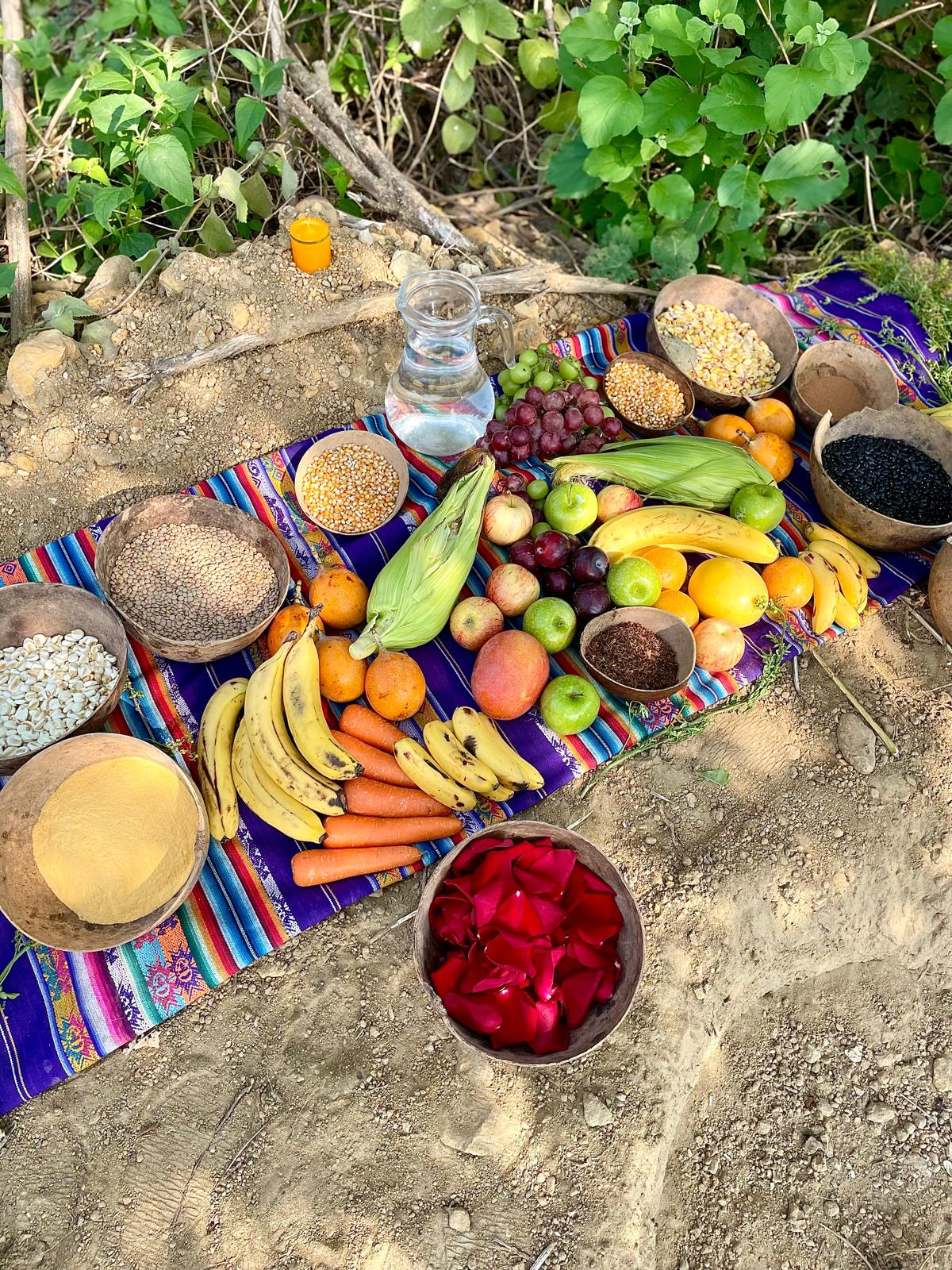
For example: This month, I will make more time to care for the natural spaces around me. Let the intention be specific enough to guide your actions, but also unfold in its own way. You can also do an offering to the Earth, with grains, fruits, stones or crystals, which have supported you during the past 28 days. While doing the offering, you can also sing a song or raise a prayer for what has passed and what is to come.
Return to your intention throughout the lunar cycle and notice what you learn from putting it into practice.
Returning to Reciprocity: Join Us at Ayllu Medicina
Ayni reminds us that life is shaped by relationships. We receive and are supported by the Earth, our communities, and from the people who accompany us along the way. We also have opportunities to contribute through our actions, attention, and care.
At Ayllu Medicina retreats, on the coast of Ecuador, time in nature is part of the opportunity to step away from familiar routines and experience a different pace of life.
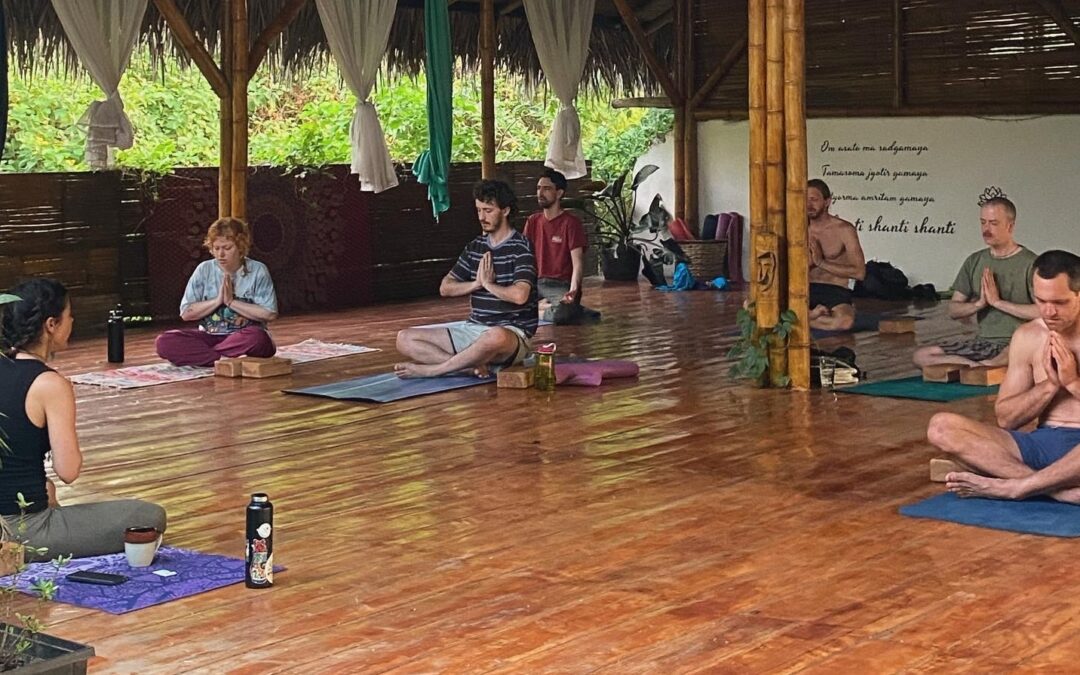
Through our retreat experiences, practices such as meditation, yoga, breathwork, and time connecting with the elements in an intentional way, offer opportunities to observe the body, mind, and surrounding environment with greater attention. Our plant medicine retreats also honor ancient traditions and practices, approached within the wider context of preparation, reflection, and integration.
If you feel called to explore these practices more deeply, take a week at Ayllu Medicina on the Ecuadorian coast to turn your attention inward, reconnect with nature, and explore how to bring greater balance between your inner world and the world around you. Discover our retreats, connect with the elements, and make space to deepen your relationship with yourself and the natural world.
by Emma Reeves | Sep 10, 2026 | spiritual practices
We tend to think of clutter as something physical. A cupboard becomes overcrowded, our desk fills with things we no longer use, or our home slowly accumulates objects that once had a purpose but no longer do. Did you know our inner world can become cluttered in the same way?
We accumulate experiences, conversations, disappointments, expectations, responsibilities and old ways of seeing ourselves. Some of these are still relevant, while others belong to a different period of our lives. Without taking time to review and release them, they can continue taking up attention even when the circumstances themselves have already changed.
There is a natural rhythm to life that is constantly reminding us that things change. The seasons move from one to another, the moon passes through its phases and the body moves through its own cycles. Yet our lives do not always give us the time or space to acknowledge these changes. We can move from one experience to the next without stopping to recognize that something has actually ended.
This is one reason closing cycles matters. It is not about constantly analyzing the past or turning every ending into a significant event. It is about periodically looking at what we are carrying, recognizing what has completed itself and allowing ourselves to put down what no longer needs to come with us. With Equinox on the horizon, it is the perfect time to look at what is out of balance in your life before this cycle closure.
Meditation offers a simple way to do this because it brings us back to the present. When we sit quietly, we begin to notice just how much of our attention is somewhere else. We replay what happened yesterday, anticipate what might happen tomorrow or return to situations that happened years ago. Through meditation, we practice noticing this movement and gently returning to what is happening now.
Read on to learn more about the importance of closing cycles and how meditation can help.
Staying Present When Our Attention Is Elsewhere
We can be physically present while our minds are somewhere completely different. We may be having breakfast while thinking about yesterday’s conversation, walking through nature while planning next week’s responsibilities or spending time with someone we love while replaying something that happened years ago.
Meditation makes this movement easier to notice. When we sit quietly and bring our attention to the breath, the mind inevitably wanders. We remember, plan, judge and imagine. The practice is not to prevent this from happening but to recognize it and gently return.
With time, this becomes more than a meditation technique. We begin to notice when our attention has become caught in an old story or when we are giving something from the past more attention than the present actually requires. This awareness is an important part of closing cycles because we cannot let go of what we have not noticed we are carrying.
At Ayllu Medicina, meditation and awareness are approached as practices for developing a deeper relationship with the present moment. Rather than trying to control every thought, the practice invites us to observe what is arising and become aware of the mind without automatically believing or following everything it produces.
Recapping Before We Release
Letting go is sometimes presented as a decision we can simply make. In reality, it is difficult to release something that we have never taken the time to understand. Before we move on from a period of our lives, it can be valuable to pause and recap what has happened.
Remember the event in as much detail as possible, including the emotions, the visuals, and how you felt. Reflect on if there are any learnings, patterns, or feelings to acknowledge.
This kind of reflection is different from rumination. Rumination keeps taking us back to the same thought without changing our relationship with it. Reflection has a purpose. We look back so that we can understand, integrate and decide what we want to bring forward.
Meditation can give us a calmer place from which to do this. Rather than becoming completely absorbed in the story, we can notice the thoughts, emotions and sensations that arise as we reflect. We might discover that something we thought we needed to hold onto has already served its purpose.
Manage Mental and Emotional Clutter
We tend to recognize physical clutter much more easily than mental clutter. We know when a cupboard is too full, but it is harder to see how much space an old resentment, an unresolved conversation or an outdated expectation is taking up in our minds.
We can carry the need to prove ourselves to someone who is no longer part of our lives. We can continue expecting a person to behave in a particular way even though the relationship has changed. We can keep defining ourselves by something that happened many years ago, allowing an old experience to influence decisions that have nothing to do with it.
This does not mean difficult emotions should simply be pushed away. Grief, anger and disappointment often need to be felt and understood. Closing a cycle is not about pretending something did not matter so that we can move on quickly. It is about giving an experience enough attention that we can understand what it has to teach us and decide whether we need to continue carrying it.
Meditation helps us develop this capacity. When we sit with an uncomfortable thought or feeling without immediately distracting ourselves, we learn that we can experience discomfort without necessarily reacting to it. We begin to see that thoughts and emotions change. They arise, remain for a time and eventually move.
This can be a practical reminder that we do not have to hold onto everything simply because it once mattered.
Closing a Cycle on New Year Is Overwhelming
The Equinox and Solstice can be a natural reminder to pause. As one season changes into another, we can take a moment to notice what has shifted in our own lives and what we want to leave behind. The natural world itself shows us that change does not happen all at once. There is movement, transition and eventually another beginning.
The New Moon offers another recurring opportunity to turn inward. With little or no visible moonlight, it can be a quieter point in the lunar cycle and a useful time for reflection and renewal. Before deciding what we want to create next, we can ask what needs to be cleared. At Aylly Medicina, we always do an earth offering to take a moment to give thanks, reflect, and set intentions for the next cycle.
You can ask questions such as:
- What has completed since the previous cycle?
- What am I still giving my energy to?
- What am I grateful for?
- What would I like to release?
- What seeds do I want to plant, and what seeds do I want to tend to?
New Year’s eve in the Gregorian calendar is a time that many people recap. But our lives do not operate on an annual schedule, so much happens in a month, let alone a year! Once a year is not enough to reflect on everything we experience.
So pick another time. The menstrual cycle offers a monthly rhythm of change, release and renewal. New Moon is a monthly opportunity to recap, regardless of gender. Birthdays provide an opportunity to look back at the year that has passed, not only at the goals we have achieved or failed to achieve.
There are also countless smaller cycles that do not appear on any calendar. A period of work comes to an end. A friendship changes. A child becomes more independent. A habit falls away. Something we once wanted no longer feels right.
If we wait until the end of the year to clear everything, we can spend months carrying what could have been acknowledged much earlier. A regular meditation practice gives us another option by creating a simple way to check in with ourselves throughout the year, not only on regular events, but each day as part of our everyday practice.
What Happens When We Do Not Close Cycles?
When we continually carry old experiences forward, they can begin to shape the present without us realizing it. We may react to a new situation based on something that happened long ago, compare new relationships with old ones or continue pursuing a goal because it once mattered, even though our priorities have changed.
The past can become part of the lens through which we see everything else. Sometimes we are physically present in one situation while mentally occupied by another, and this can affect our relationships, our decisions and our ability to experience what is happening in front of us.
Meditation can help us recognize these patterns because it makes repetition more visible. When we sit quietly, we may notice the same thoughts returning, the same concerns appearing or the same stories being repeated.
This is not about judging the mind for doing what minds do. The practice is to notice and return to the present moment. As this becomes more familiar, we can start distinguishing between something that genuinely needs our attention and something we have simply become accustomed to carrying. That distinction can create more freedom in everyday life.
Where Plant Medicine Comes Into the Process
Plant medicine can offer another context for looking at what we carry. In ceremony, away from many of the routines and distractions of everyday life, we may become more aware of patterns, emotions or experiences that are difficult to see clearly in our normal surroundings.
A ceremony can offer a different perspective and sometimes bring something into awareness that has been sitting beneath the surface for a long time. This might be an old pattern in relationships, a belief about ourselves, a fear that has been influencing our choices or an experience that we have never fully processed.
However, plant medicine is not about collecting powerful experiences or expecting a ceremony to solve everything for us. What happens afterwards matters.
At Ayllu Medicina, plant medicine is approached as part of a wider process that includes preparation, ceremony and integration. Meditation is one of the practices that can support this process, helping participants develop awareness before ceremony and continue observing what arises afterwards. The retreat environment also brings together practices such as meditation, yoga, nature and ritual, creating different ways to connect with the experience and with oneself.
After a ceremony, there can be a temptation to immediately interpret everything that happened. Sometimes it is more valuable to create space and observe what remains. An insight may become clearer with time, while an emotion may need to be felt rather than explained. Something that seemed obvious during the ceremony may look different once we return to ordinary life, which is why meditation is one of the practices we share to offer a place to continue listening.
Closing Cycles as an Ongoing Practice
We do not clear physical clutter once and expect our homes to remain empty forever. Life continues, and things accumulate again. Our inner world works in much the same way.
This is why closing cycles can become an ongoing practice rather than something reserved for New Year’s Eve or a major life transition. The New Moon can become a monthly reminder to pause and clear some space. The Equinox and Solstice can offer a seasonal checkpoint. A birthday can be a chance to recap the year. Your monthly menstrual cycle, the transition into menopause or the end of a particular period of life can provide another opportunity to reflect.
But we can also do it on an ordinary day when we notice that our minds feel crowded.
We can sit for a few minutes, follow the breath and ask ourselves what has been occupying our attention. We can notice what we are holding onto, what we have learned and what we may be ready to release. There may be something practical that needs to be addressed, a conversation that needs to happen or an emotion that needs more time.
We do not need to force an ending simply because we have decided that something should be over. The practice is to become aware of what is there and allow ourselves to respond consciously.
Making Space for the Present
Closing a cycle is ultimately about making more room for the present. When we are no longer spending so much energy replaying what happened, holding onto old expectations or worrying about what might happen next, we have more attention available for the life that is actually unfolding around us. We can listen more fully, respond rather than react and meet new experiences without automatically filtering them through everything that came before.
Meditation supports this process by giving us a regular practice of returning to the present. The mind wanders, we notice and we return to the breath. Over time, this simple practice can help us recognize when our attention has become caught in an old story and create enough space to choose where we want to place it instead.
Plant medicine can sometimes deepen this process by bringing patterns, emotions and experiences into a different light. At Ayllu Medicina, this work is approached through preparation, ceremony and integration, with meditation, yoga, purification and other practices forming part of a broader practice of heightening awareness. The intention is not simply to have a profound experience, but to create the conditions for awareness to become part of everyday life.
When to Close Cycles: Find a Time to Reflect
The New Moon, the Equinox, a birthday or a personal transition can all offer useful reminders to pause and take stock, but we do not have to wait for a particular date to clear some internal space. Our lives are constantly moving through cycles, and giving ourselves regular opportunities to reflect can prevent old experiences, thoughts and emotions from accumulating unnoticed.
As another season approaches, consider taking some time to look at what you have been carrying. What from the previous cycle is worth keeping? What have you learned? What are you ready to leave behind? Meditation can provide the quiet space to explore these questions without immediately needing to find an answer. Sometimes the process of closing begins simply with becoming present enough to see what is there.
Deepen Your Meditation Practice
This December, Ayllu Medicina’s plant medicine and meditation retreat in Ecuador offers a dedicated space to step away from everyday demands and give this process your full attention. Through meditation, plant medicine, sweat lodges, daily yoga, and other purification techniques, the retreat creates an opportunity to reflect on what has been, reconnect with the present and consciously make space for what comes next. Rather than carrying another year’s worth of unfinished experiences forward, the retreat offers time to pause, listen and consider what you are ready to release before beginning a new cycle.
We are also sharing two community events in Ecuador for Equinox; a women’s sweat lodge on 18th September, and on the 19th, a San Pedro ceremony. Contact us for more information.
If you would like to learn more via a virtual offering, then women can consider our first Ayllu Vidya course: The First Threshold: The Living Wisdom of the Cyclical Woman. We are now opening a waiting list for the next course due to begin in July 2027. Learn more here.
by Ayllu Medicina Team | Jul 11, 2026 | spiritual practices
Article written by Anahata Ishaya & Hwaneetah
Fear is one of the most misunderstood human emotions. Most of us spend our lives trying to avoid it, silence it, and overcome it. We see fear as something standing between us and the life we long for, whereas fear and healing can work together.
We assume that if we could simply get rid of fear, we would finally feel free. But what if fear was never the obstacle, but rather an invitation into healing? What is fear isn’t your enemy?
No matter how long we’ve walked a spiritual path, how much healing we’ve done, or how many ceremonies we’ve experienced, fear still visits us. It appears before making an important decision, opening our hearts after they’ve been broken, speaking our truth, closing a chapter, beginning a new project, or simply when life asks us to step beyond what feels familiar.
Fear is part of being human, so the question is not whether fear will arise. Instead, the question is who we become when it does.
For years, we have been taught to believe that courage means living without fear. Yet true courage has never been the absence of fear. It is the willingness to move forward with an open heart despite it.
Over time, I’ve come to see that what we fear most often points directly toward where our soul is ready to expand. Fear tends to appear just before a profound transformation. It is not the wall blocking our path; it is the guardian standing at the threshold of growth.
Every time we choose presence over panic, curiosity over resistance, and trust over control, we begin to transform our relationship with fear. And in doing so, we discover that the freedom we have been seeking was never found in eliminating fear, but in learning to walk through it.
Here are some ways of transforming fear into wisdom.
Fear is Designed to Protect Us
Fear is one of the body’s oldest survival mechanisms. Without it, our ancestors would not have survived. It is the intelligent response that prepares us to react when danger is present.
The challenge is that our nervous system doesn’t always distinguish between a real threat and an imagined one. Today, our body can react to a difficult conversation, starting a business, changing careers, ending a relationship, or speaking in front of a group with the very same physiological response it would have if we were facing a predator.
Our heart races, breathing can become shallow, our muscles tighten, and stress hormones surge through the body. At the same time, the mind begins creating stories about everything that could go wrong. Long before anything has actually happened, we are already living inside an imagined future.
Much of human suffering comes not from reality itself, but from our anticipation of it. This is why it is time to reframe fear, understand its origins, and learn why fear is not your enemy.
Learned Fears: We Learn to Be Afraid
No one is born believing they are not enough. No child enters the world ashamed of their voice, afraid of failure, or convinced they must earn love by being perfect. This is because many of our deepest fears are learned.
Our fears are shaped through painful experiences, rejection, criticism, disappointment, trauma, family conditioning, and the messages we absorb from society. Little by little, we learn to avoid mistakes, discomfort, vulnerability, and disappointment. Eventually, instead of asking ourselves what we truly desire, we begin asking what feels safe.
Without realizing it, fear slowly starts making our decisions for us. And when fear becomes the architect of our lives, our world becomes smaller than it was ever meant to be. It is important to remember this on your inner healing journey, so you can gently lay the fear armor down, give thanks, and transform it.
Fear Doesn’t Always Mean “Stop”
One of the greatest misunderstandings about fear is believing that if we feel afraid, we must be on the wrong path. Yet often the opposite is true.
Fear doesn’t always say, “Turn back.”
More often, it is saying;
- “You’re entering unfamiliar territory.”
- “You’re leaving behind an old version of yourself.”
- “You’re growing.”
Every meaningful transformation requires us to step into the unknown, and every new beginning asks us to release something familiar.
Growth has always required uncertainty. If you look honestly at your own life, you’ll likely find that the experiences which transformed you the most were also the ones that frightened you the most!
Overcoming Fear: Acknowledge It
The first step is simply to acknowledge fear, as after all, we cannot transform what we refuse to see. Ignoring fear does not make it disappear. Suppressing it only allows it to operate from beneath our awareness.
Healing begins with honesty. When fear comes up, acknowledge what is arising:
- “I’m afraid of failing.”
- “I’m afraid of being rejected.”
- “I’m afraid of not being enough.”
- “I’m afraid of losing what I love.”
The simple act of naming fear creates space between you and the emotion. You are not your fear. You are the awareness observing fear.
This single shift changes everything with your relationship with fear and emotions in general.
Fear as a Teacher: Lessons from Fear
Rather than asking, “How do I get rid of this fear?” Try asking:
- “What is this fear trying to protect?”
- “What part of me feels vulnerable?”
- “What story am I still carrying?”
Fear often points toward the places within us that are ready to heal. If you’re afraid of speaking your truth, perhaps your voice has been waiting to be heard. If you’re afraid of setting boundaries, perhaps your self-worth is asking to grow stronger.
If you’re afraid of change, perhaps life has already outgrown the version of yourself you’ve been holding onto. When we stop fighting fear, we can finally begin listening to its deeper message.
Sometimes fear isn’t trying to stop us. It can sometimes be preparing us. This reframing of fear can help you stop resisting fear, and tune into what its telling you.
Courage Is Built One Small Step at a Time
Courage is often misunderstood as fearlessness, but in reality, it is choosing to move despite fear. Every difficult conversation, every honest decision, every boundary we finally set, and every dream we begin before we feel completely ready becomes a small step that teaches the nervous system something powerful.
Try this simple mantra in times when you need emotional resilience:
“I can do difficult things.”
And remember: confidence does not come before action. tI grows because of action. Every courageous choice expands what we believe is possible.
Presence Is the Antidote to Fear
Fear almost always lives in the future. Peace exists only in the present moment.
When we return to our breath, feel our feet on the Earth, and bring awareness back into the body, we interrupt the endless stories created by the mind. A simple practice can change everything:
- The next time fear arises, pause.
- Take three slow breaths.
- Notice where fear lives inside your body.
- Observe it with curiosity rather than judgment.
- You may discover that the physical sensation itself lasts only a few moments.
What keeps suffering alive is often not the sensation, but the story we continue telling ourselves about it. Presence allows us to separate the two, coming back to being the observer, in the present, in peace.
You Were Never Meant to Carry Fear Alone
One of the biggest ways to learn how to work with fear instead of fighting it is to seek support. Fear grows stronger in isolation. Whereas, tt softens when it is witnessed with compassion.
Speaking honestly with someone you trust, seeking support, joining a community, or allowing yourself to be held during difficult moments reminds your nervous system that you are safe.
It is important to remember that healing has never been solely an individual journey. Human beings have always healed in relationship: in community, in circles, around the fire, the list goes on!
There is profound medicine in realizing that you do not have to face every fear by yourself.
Remember Who You Truly Are
Before fear, there is awareness. There is presence, love, and intuition. There is an intelligence within you that has carried you through every challenge you’ve ever faced.
Fear may visit you. It may even stay for a while. But it is not your identity.
Every time you choose love over fear, presence over panic, and trust over control, you strengthen the person you are becoming. The challenges may not disappear, but you will no longer meet them as the same person.
Fear and Healing: An Invitation
The next time fear arises, resist the urge to push it away. Pause. Breathe. Place a hand over your heart and feel your feet grounded on the Earth. Then ask yourself:
What part of me is being invited to grow right now?
Stay with the question and allow the answer to unfold in its own time. You may discover that what once seemed like a wall was actually a doorway, and that on the other side of fear was the freedom you had been seeking all along.
The next time fear arises, instead of fighting it, remember this question: What if fear isn’t your enemy? Fear and healing are deeply connected. When you learn to meet fear with curiosity instead of resistance, it can become a guide for growth, self-awareness, and lasting transformation.
At
Ayllu Medicina Plant Medicine Retreats, we share practical tools to help regulate your nervous system and return to your center, both in ceremony and in daily life. Learning how to navigate fear and other emotions with awareness supports your inner healing journey and helps you reconnect with your true nature.
During our retreats, you’ll experience daily yoga, meditation, breathwork, and traditional healing practices in a supportive environment. Our first retreat of the season begins in December 2026 with our
Meditation and Plant Medicine Retreat. Reserve your space today with a deposit!
Article written by Anahata Ishaya & Hwaneetah
by Ayllu Medicina Team | Apr 19, 2026 | spiritual practices
Article written by Anahata & Hwaneetah
There are moments in the cycle where life does not ask you to expand. It asks you to become honest. The New Moon is one of those thresholds. So, what can you do on New Moon?
New Moon is a time where the light disappears, not as absence, but as an invitation. It is an Invitation to return to the unseen. To the quiet. To return to what has been running underneath your choices, your words, your relationships, and your direction.
New Moon is not the time to perform. It’s time to become real.
At Ayllu Medicina, we understand the New Moon not as emptiness, but as a reset point of truth. It is a moment where the noise lowers enough for you to hear what is actually aligned and what is not. Read on to discover what to do on New Moon, how to make the most of this time as an opportunity to align and reset the next cycle.
Truth Is Not a Concept: It Is a State
Truth is not what you say. Truth is what your system is living. After all, you can speak beautiful words and still be out of alignment. You can try and convince others, and still feel the internal friction.
This is because truth is not mental.It is somatic, energetic, and felt. Truth shows up as coherence, as a quiet steadiness, and as a lack of inner negotiation.
When you are in truth, there is less noise. There is less justification. And there is less effort to hold things together.
And when you are out of truth, something in you knows: there is tension, overthinking, and a subtle exhaustion. The body always recognizes this misalignment before the mind is willing to admit it.
Where You Are Out of Alignment
The New Moon does not ask you to set intentions for who you wish to be. It asks you to look at where you are not being honest:
- Where are you saying yes when your body says no?
- Where are you maintaining something that no longer feels true?
- Where are you performing a version of yourself that is no longer alive?
And remember: misalignment is not failure. It is feedback.
But most people override it. They adapt. They justify. They stay longer than they should.
They move faster than they feel. And slowly, they drift further from themselves.
Truth does not drift. It remains steady — waiting for you to return. The New Moon is an opportunity to align once again.
The Cost of Not Living in Truth
Living out of alignment does not always look dramatic. It looks subtle. For example, it looks like tiredness you cannot explain. It looks like decisions that feel heavy. It looks like relationships that require effort instead of presence.
Over time, misalignment fragments your energy. You begin to split, between what you feel and what you show, between what you know and what you choose.
And that split creates noise in the system. The more noise, the harder it becomes to hear yourself. This is why coming back to the truth is not just emotional work.
It is energetic hygiene.
The New Moon as a Reset
The New Moon offers a clean space — not to build something new immediately, but to clear what is not true or aligned.
Remember: before intention, there must be honesty. Before direction, there must be alignment. Before movement, there must be stillness.
The New Moon phase each month invites you to sit with what is real, without rushing to fix it or needing to transform it instantly.
Instead, New Moon offers a chance to just see it clearly, without distortion. Because clarity itself reorganizes the system.
Truth Requires Letting Go
Alignment is not only about choosing what is right. It is about releasing what is not. And this is where most people hesitate. Because letting go requires facing the parts of life that were once aligned, but are no longer.
For example, it requires ending dynamics that feel familiar. It requires stepping out of roles that once gave you identity. It requires trusting what you feel, even when it disrupts what you have built.
Truth is not always comfortable. But it is always clean. And what is clean creates movement.
What to Do on New Moon: The Practice of Returning to Truth
During New Moon, keep it simple. New Moon is a time to slow down. You can reduce external noise and create space in your day where nothing is filling you.
Sit with yourself without distraction. Then ask:
- What feels true right now?
- Not what should be true.
- Not what used to be true.
- What is true now?
Notice where your body softens. Notice where it contracts. Truth does not shout. It reveals itself in subtle coherence.
And when you feel it (even if it is inconvenient), do not rush to act.
First, acknowledge it. Then begin to orient your life toward it. Small movements are enough.
Alignment is not a dramatic shift. It is a series of honest adjustments. Start on New Moon with a recap of your month and an offering to the Earth to give thanks for all that happened in the past 28-day cycle.
The New Moon Invitation
New Moon is a return. A return to what is honest. A return to what is simple. A return to what does not require you to perform.
Not everything needs to be decided now. But everything can be seen. And what is seen, with clarity, begins to shift.
So instead of asking:
“What do I want to create?”
Ask:
“What is true for me now — and what am I ready to stop carrying that no longer is?”
Stay there: in that question, in that stillness, in that honesty. That is where alignment begins. And from alignment — everything else follows.
The Ayllu Medicina Way: What to Do on New Moon
At Ayllu Medicina, we do not rush transformation. We create conditions where truth can emerge. Because when truth is seen clearly, without resistance, without distortion — the system reorganizes naturally.
You do not need to force change. You need to stop interfering with what is already known within you. This is the deeper work.
The work is not becoming someone new. But removing what is not aligned, so what is real can take its place.
We always give an offering to the Earth on New Moon, taking the time to be in nature, without distractions. We take the time to recap on our month, what happened, what feels ready to be released, what seeds can be planted, and what needs to continue to be nourished. We also always share a New Moon newsletter, which you are welcome to join. Contact us to be added to the Ayllu Medicina email list.
Do you want to take time to align and explore your inner world? Join us here on the coast of Ecuador for one of our plant medicine retreats, an 8-day journey to your true self. We have two more plant medicine retreats this season, with availability, and our next season retreat dates are now live.
Anahata is our medicine guide’s (Hwaneetah’s) mum. She is an Ishaya meditation monk and teacher. You can connect with her and take her meditation course for a deep dive into these ascension meditation techniques and allow presence to become your nature.
Click the links below or contact us directly to learn more:
https://www.facebook.com/portal.juaica
https://www.instagram.com/constanzaballesterosb/
anahataishaya@gmail.com
Article Written By Anahtata & Hwaneetah

by Ayllu Medicina Team | Feb 20, 2026 | spiritual practices
Article written by Anahata Ishaya and Hwaneetah
versión en español
There is a place before our reactions. Before the story begins. Before we label something as “this is good” or “this is bad.”
This is the place before preference, which, at Ayllu Medicina we call the Zero Point. In other words, neutrality. In some Indigenous cultures of Colombia, what we translate as “love” is not described as passion, romance, or attachment, but as neutrality, this zero center.
You can also think about it as a steady center. The balanced heart. A consciousness that does not collapse into polarity.
It may sound like a poetic metaphor, but this medicine of neutrality is also a technology of awareness, and when we can connect with it, we step into the role of the witness. Read on to learn how the discipline of becoming the witness helps in ceremony and life – and how you can begin to connect with this medicine.
The Architecture of Reality: Polarity and the Void
Everything in existence arises through polarity, including:
- Expansion and contraction.
- Light and shadow.
- Creation and dissolution.
- Pleasure and pain.
What Taoist cosmology names Yin and Yang are not opposites fighting for dominance. Instead, they are complementary forces emerging from the same origin. Both are born from the same invisible field. They are anchored to what mystics and physicists alike describe as a fertile emptiness, also known as the Void, the field of pure potential, or the Zero Point.
Nothing can exist without its counterbalance. The luminous needs the dark to be visible. For example, fulfillment is shaped by longing. Strength is sculpted by resistance. Even the breath is an oscillation between in and out.
Yet the human mind is deeply uncomfortable with this design. We are conditioned to chase one pole and exile the other. We want expansion without contraction, pleasure without discomfort, union without vulnerability, success without risk – the list goes on.
And so we resist half of reality. Or at least try to, as this resistance does not remove what we reject. It internalizes it.
The result? Repression becomes subconscious energy. Subconscious energy becomes frequency. And your frequency shapes lived experience.
After all, we do not attract what we want. We attract what we are resonating with, consciously or unconsciously.
And what are we resonating with? The patterns we carry in our nervous system. The judgments we repeat internally. The fears we deny. The aspects of life we refuse to make space for.
The “negative” shows up not as punishment, but as reflection. For example:
- When we fear loss but pretend we do not, that fear shapes how we love.
- When we fear rejection but suppress it, that fear shapes how we show up in work.
- When we fear failure but deny it, that fear governs our decisions.
So, how do we break these patterns? Neutrality is the medicine. Neutrality interrupts this unconscious magnetism.
Fear as Intelligent Companion
Neutrality is not the absence of fear. It has a mature relationship with it, working with it as an intelligent companion.
To sustain a relationship, we must acknowledge the possibility of loss. To build a mission-driven life, we must accept the possibility of rejection. To train the body, we must respect the possibility of injury.
This is not limiting fear. It is conscious fear; fear that informs rather than controls.
Neutrality says: “I see the possibility of pain. I do not deny it. I do not obsess over it. I allow it to exist, and I continue forward with clarity.”
This posture creates resilience. When we stop resisting one pole of life, we stop generating unconscious tension around it. The nervous system softens. The mind becomes less reactive. Decision-making becomes precise instead of defensive, and fear becomes a companion we can consciously work with.
The Witness State: The Inner Laboratory
Neutrality is a discipline of consciousness. It is the training of the mind to pause before an impulsive reaction. To observe thought instead of automatically identifying with it. To feel emotion fully without becoming consumed by it.
In this state, consciousness becomes the witness rather than the actor. We are not talking about dissociation. This state is heightened awareness.
Imagine the mind as a laboratory. Instead of instantly labeling an experience as good or bad, you observe it. You track the sensation in the body. You notice the narrative forming. You examine the impulse to react.
You create space. And in that space, something extraordinary happens: freedom.
Most suffering is not created by the event itself, but by the mental story and reactive cascade that follows it.
Neutrality short-circuits this cascade. It reduces unnecessary conflict. It softens social anxiety. It transforms emotional overwhelm into information.
The witness does not suppress emotion. The witness does not dramatize emotion. The witness holds emotion within a wider field of awareness.
Becoming the witness is high-level nervous system regulation. When practiced, it is mastery over your mental capacities.
Neutrality in a Plant Medicine Ceremony
In plant medicine ceremonies, such as Ayahuasca ceremonies and San Pedro ceremonies, polarity intensifies:
- Joy can become ecstatic
- Grief can become oceanic.
- Fear can surface from ancestral layers.
- Insight can feel cosmic.
When intensity rises, the instinct of the ego is to grasp or to resist. It may want to cling to the light, to fight the shadow, or to define the experience too quickly.
Neutrality invites something different in plant medicine ceremonies. Instead of identifying with every emotional wave, you witness it. Instead of declaring, “This is who I am,” you recognize, “This is what is moving through me.” Instead of chasing bliss or avoiding discomfort, you allow both to exist without collapsing into either.
This is where true transformation occurs. When neutrality is present, revelation does not inflate the ego, and shadow does not generate shame.
Sensations move. Emotions crest and dissolve. Insights land without distortion.
The experience passes through, and wisdom remains. Neutrality becomes the invisible container within you. And that inner container is what makes deep medicine sustainable and able to be integrated.
Neutrality as Love
If love is not attachment, what is it? If love is not emotional intensity, what is it?
In traditions where love is synonymous with neutrality, the teaching is radical:
- Love is a balanced presence.
- Love is the capacity to remain steady when polarity arises.
- Love is the refusal to weaponize preference.
- Love is the discipline of not projecting unconscious fear onto another.
Love is Zero Point awareness in relationships. For example, when you can witness your fear of loss without controlling your partner, that is love. When you can witness your insecurity without attacking your work, that is love.
And, when you can witness your anger without becoming it, that is love. Neutrality does not diminish the depth of the relationship; it refines it, allowing us to engage in life fully without being overtaken or losing our center.
The Daily Practice of Returning to Center
A plant medicine ceremony is a training ground, and life is the real practice. How can you stay neutral during your plant medicine integration and everyday life?
It is not just about the big moments. Neutrality is cultivated in the micro-moments, such as:
- When someone disagrees with you.
- When your plans collapse.
- When praise arrives.
- When criticism lands.
So, how can you integrate the medicine of neutrality? First: pause. Breathe deeply before reacting.
Notice the judgment forming in the mind. Observe the tightening in the body. Name the fear gently. And, return to the witness.
This discipline of returning to the witness is not suppression. It is conscious detachment. You are not eliminating polarity; you are anchoring in the center of it.
Over time, this practice of returning to neutrality rewires your nervous system. The automatic becomes intentional. The reactive becomes responsive. The mind becomes less binary and more spacious.
You begin to live from the Zero Point.
Join the Ayllu Medicina Vision
At Ayllu Medicina, we do not chase only peak states or transcendent experiences. We cultivate stability within expansion. We teach nervous system literacy alongside spiritual openings during our plant medicine retreats.
We anchor revelation in grounded awareness that you can take with you back to the ceremony of life. Because true medicine is not about escaping polarity. It is about integrating it.
The Zero Point is fertile. It is not empty in the sense of absence. It is empty of distortion.
It is the field before judgment, before story, before projection. It is where light and shadow coexist without war. And from that field, wise, conscious action emerges.
Our invitation is simple, but profound. Ask yourself:
- Where are you resisting half of reality?
- What are you rejecting that secretly governs you?
- Can you meet your fear without suppression?
- Can you meet your joy without clinging?
- Can you remain steady at the center?
Neutrality is not passive, it is powerful. Nor is it cold. It is clear.
It is not detached from life, it allows you to become deeply available to all life has to offer.
This is the discipline of the witness, the main technology of awareness, and love
as balance. And every time you return to the Zero Point, in a plant medicine ceremony, in conflict, in intimacy, or in decision; you reset your field.
You come back to clarity, presence, and most importantly, yourself.
Do you want to connect with the medicines of San Pedro and Ayahuasca? Do you want to receive tools to use in your everyday life, such as learning to return to neutrality? Join us at one of our upcoming plant medicine retreats.
Anahata is our medicine guide’s (Hwaneetah’s) mum. She is an Ishaya meditation monk and teacher. You can connect with her and take her meditation course for a deep dive into these ascension meditation techniques and allow presence to become your nature.
Click the links below or contact us directly to learn more:
https://www.facebook.com/portal.juaica
https://www.instagram.com/constanzaballesterosb/
anahataishaya@gmail.com
Article Written By Anahtata & Hwaneetah
Neutralidad del Punto Cero
La Disciplina del Testigo en la Ceremonia y en la Vida
Hay un lugar antes de la reacción. Antes de la historia. Antes de “esto es bueno” y “esto es malo”.
Un lugar antes de la preferencia. En Ayllu Medicina lo llamamos Punto Cero.
Y en algunas culturas indígenas de Colombia, lo que nosotros traducimos como “amor” no se describe como pasión, romance o apego, sino como neutralidad. Un corazón equilibrado. Una conciencia estable. Una presencia que no colapsa en la polaridad.
Esto no es una metáfora poética. Es una tecnología de la conciencia.
La Arquitectura de la Realidad: Polaridad y Vacío
Todo en la existencia surge a través de la polaridad:
- Expansión y contracción.
- Luz y sombra.
- Creación y disolución.
- Placer y dolor.
Lo que la cosmología taoísta llama Yin y Yang no son opuestos en guerra, sino fuerzas complementarias que emergen del mismo origen. Ambas nacen del mismo campo invisible. Ambas están ancladas a lo que místicos y físicos han descrito como un vacío fértil — el campo de potencial puro, el Punto Cero.
Nada puede existir sin su contraparte. Lo luminoso necesita la oscuridad para ser visible. La plenitud se define por el anhelo. La fortaleza se esculpe a través de la resistencia. Incluso la respiración es una oscilación entre inhalar y exhalar.
Sin embargo, la mente humana se incomoda profundamente con este diseño.
Estamos condicionados a perseguir un polo y exiliar el otro.
Queremos expansión sin contracción.
Placer sin incomodidad.
Unión sin vulnerabilidad.
Éxito sin riesgo.
Y así, resistimos la mitad de la realidad. Pero aquello que rechazamos no desaparece. Se internaliza.
La represión se convierte en energía subconsciente. La energía subconsciente se convierte en frecuencia. La frecuencia moldea la experiencia.
No atraemos lo que queremos. Atraemos lo que somos — lo que estamos vibrando consciente o inconscientemente.
¿Y qué somos? Somos nuestros patrones. Somos nuestras narrativas internas. Somos los miedos que negamos y las partes de la vida a las que no les damos espacio.
Lo “negativo” no aparece como castigo, sino como reflejo. Cuando tememos la pérdida pero fingimos que no, ese miedo da forma a cómo amamos. Cuando tememos el rechazo pero lo reprimimos, ese miedo influye en cómo nos mostramos en el trabajo. Cuando tememos el fracaso pero lo negamos, ese miedo gobierna nuestras decisiones.
La neutralidad interrumpe esta magnetización inconsciente.
El Miedo como Compañero Inteligente
La neutralidad no es ausencia de miedo. Es una relación madura con él.
Para sostener una relación, debemos reconocer la posibilidad de pérdida.Para construir una misión con propósito, debemos aceptar la posibilidad de rechazo. Para entrenar el cuerpo, debemos respetar la posibilidad de lesión.
Este no es un miedo limitante. Es un miedo consciente — un miedo que informa, no que domina.
La neutralidad dice: “Veo la posibilidad del dolor. No lo niego. No me obsesiono con él. Le permito existir, y continúo avanzando con claridad.”
Esta postura crea resiliencia.
Cuando dejamos de resistir un polo de la vida, dejamos de generar tensión inconsciente alrededor de él. El sistema nervioso se suaviza. La mente reacciona menos. Las decisiones se vuelven más precisas y menos defensivas.
El estado del Testigo: el Laboratorio Interior
La neutralidad es una disciplina de la conciencia.
Es entrenar la mente para pausar antes de reaccionar impulsivamente. Es observar el pensamiento en lugar de identificarse automáticamente con él. Es sentir la emoción completamente sin convertirse en ella.
En este estado, la conciencia se convierte en el testigo en lugar del actor.
Esto no es disociación. Es mayor lucidez.
Imagina la mente como un laboratorio. En lugar de etiquetar inmediatamente una experiencia como buena o mala, la observas. Percibes la sensación en el cuerpo. Notas la narrativa que comienza a formarse. Reconoces el impulso de reaccionar.
Y creas espacio. En ese espacio vive la libertad.
La mayoría del sufrimiento no proviene del evento en sí, sino de la historia mental y la cascada reactiva que le sigue. La neutralidad interrumpe esa cascada. Reduce conflictos innecesarios. Suaviza la ansiedad. Transforma el desborde emocional en información.
El testigo no suprime la emoción. El testigo no dramatiza la emoción. El testigo sostiene la emoción dentro de un campo más amplio de conciencia.
Esto es regulación profunda del sistema nervioso. Esto es maestría mental.
Neutralidad en la Ceremonia
En las ceremonias de medicina, la polaridad se intensifica.
- La alegría puede volverse extática.
- El duelo puede volverse oceánico.
- El miedo puede surgir desde capas ancestrales.
- La revelación puede sentirse cósmica.
Cuando la intensidad aumenta, el ego quiere aferrarse o resistir — quiere perseguir la luz o luchar contra la sombra, quiere definir demasiado rápido lo que está ocurriendo.
La neutralidad invita a algo diferente. En lugar de identificarte con cada ola emocional, la observas. En lugar de declarar “esto soy yo”, reconoces “esto se está moviendo a través de mí”. En lugar de perseguir el éxtasis o evitar la incomodidad, permites que ambos existan sin colapsar en ninguno.
Aquí es donde ocurre la verdadera transformación. Cuando hay neutralidad, la revelación no infla el ego y la sombra no genera vergüenza. Las sensaciones se mueven. Las emociones suben y bajan. Las comprensiones aterrizan sin distorsión.
La experiencia atraviesa. La sabiduría permanece.
La neutralidad se convierte en el contenedor invisible dentro de ti. Y ese contenedor interno es lo que hace que la medicina sea sostenible.
Neutralidad como Amor
Si el amor no es apego, ¿qué es? Si el amor no es intensidad emocional, ¿qué es?
En las tradiciones donde amor y neutralidad son sinónimos, la enseñanza es radical:
- Amor es presencia equilibrada.
- Amor es permanecer estable cuando surge la polaridad.
- Amor es no usar la preferencia como arma.
- Amor es no proyectar miedo inconsciente sobre el otro.
- Amor es conciencia del Punto Cero en relación.
Cuando puedes observar tu miedo a la pérdida sin controlar a tu pareja, eso es amor. Cuando puedes observar tu inseguridad sin sabotear tu trabajo, eso es amor. Cuando puedes observar tu enojo sin convertirte en él, eso es amor.
La neutralidad no disminuye la profundidad. La refina. Te permite involucrarte plenamente con la vida sin ser poseído por ella.
La Práctica Diaria de Volver al Centro
La ceremonia es un campo de entrenamiento. La vida es la práctica real. La neutralidad se cultiva en los micro-momentos:
- Cuando alguien te contradice.
- Cuando tus planes se desmoronan.
- Cuando llega el elogio.
- Cuando llega la crítica.
Pausa. Respira profundamente antes de reaccionar. Observa el juicio formándose en la mente.
Percibe la tensión en el cuerpo. Nombra el miedo suavemente. Regresa al testigo.
Esto no es supresión. Es desapego consciente.
No estás eliminando la polaridad. Estás anclándote en su centro.
Con el tiempo, esta práctica reconfigura el sistema nervioso. Lo automático se vuelve intencional. Lo reactivo se transforma en respuesta consciente. La mente se vuelve más espaciosa, menos binaria.
Comienzas a vivir desde el Punto Cero.
La visión de Ayllu Medicina
En Ayllu Medicina no perseguimos únicamente estados elevados o experiencias trascendentales. Cultivamos estabilidad dentro de la expansión. Enseñamos alfabetización del sistema nervioso junto con apertura espiritual. Anclamos la revelación en conciencia encarnada.
Porque la verdadera medicina no consiste en escapar de la polaridad. Consiste en integrarla.
El Punto Cero es fértil. No es vacío como ausencia, sino vacío de distorsión. Es el campo antes del juicio, antes de la historia, antes de la proyección. Es donde luz y sombra coexisten sin guerra.
Y desde ese campo emerge la acción sabia. La invitación es simple — pero profunda:
¿Dónde estás resistiendo la mitad de la realidad?
¿Qué estás rechazando que secretamente te gobierna?
¿Puedes encontrarte con tu miedo sin suprimirlo?
¿Puedes encontrarte con tu alegría sin aferrarte a ella?
¿Puedes permanecer estable en el centro?
La neutralidad no es pasiva. Es poderosa. No es fría. Es clara.
No está desconectada de la vida. Está profundamente disponible a ella.
Esta es la disciplina del testigo. Esta es la tecnología de la conciencia. Este es el amor como equilibrio.
Y cada vez que regresas al Punto Cero — en la ceremonia, en el conflicto, en la intimidad, en la toma de decisiones — reinicias tu campo.
Regresas a la claridad. Regresas a la presencia. Regresas a ti.
¿Quieres conectar con las medicinas de San Pedro y Ayahuasca? ¿Quieres recibir herramientas para usar en tu vida cotidiana, como aprender a volver a la neutralidad? Únete a uno de nuestros próximos retiros de medicina ancestral con plantas.
https://www.facebook.com/portal.juaica
https://www.instagram.com/constanzaballesterosb/
anahataishaya@gmail.com
Anahtata Ishaya & Hwaneetah


by Ayllu Medicina Team | Jan 22, 2026 | spiritual practices
Article written by Anahata Ishaya and Hwaneetah
A common question retreat participants ask is: what are the best plant medicine preparation and integration tips? At Ayllu Medicina, we share a variety of tools and plant medicine preparation advice with our retreat participants. At the core of these tools and advice is a common theme: the return to mindful awareness.
At Ayllu Medicina, we understand mindful awareness not as a technique, but as an art of staying fully present with what is arising, moment by moment, in our direct experience. It is the practice of meeting life with openness, receptivity, and deep listening.
When we recognize ourselves within this open dimension of reality, even dormant intelligences come to life. These include ways of knowing that radically transform our relationship with life. We begin to honor the creative and compassionate potential of human consciousness, remembering that awareness itself is medicine that we can return to throughout our lives.
This way of being becomes especially supportive during plant medicine ceremonies, where staying present allows the teachings of the plants to unfold with clarity, safety, and grace. Read on to learn more about mindful awareness, its main principles, and how it helps plant medicine preparation and integration.
Foundational Principles of Mindful Awareness
The terms mindful, awareness, and presence are often used. But what do they actually mean? Mindful awareness rests on five essential qualities:
- Unconditional Receptivity
- Clarity
- Calm
- Awareness of the Here and Now
- Unconditional Love
Together, these principles form a stable inner ground from which we can meet all experiences—pleasant or unpleasant—with wisdom. Mindful awareness essentially is the ability to pay attention to the present moment, without judgment. This allows you to meet whatever comes up with clarity, calm, and curiosity, instead of falling into the mind’s chatter.
Unconditional Receptivity: Becoming a Host to Experience
Unconditional receptivity is the attitude with which we perceive everything that enters our awareness. It is activated through three subtle yet powerful actions:
- Not rejecting
- Not holding on
- Not chasing
Nothing that appears in the body, emotions, or mind is pushed away, grasped, or pursued. Instead, we become a hospitable host to experience. This receptivity applies to all six sensory fields:
- Sight
- Hearing
- Smell
- Taste
- Touch
- Mind (thoughts)
In each of these fields, we perceive sensations, stimuli, images, and events. Mindful awareness invites us to offer lucid receptivity to whatever arises—without excluding or eliminating anything.
For example, we do not cling to painful sensations or emotional patterns. We experience them openly, noticing their constant transformation, and allowing attachments to gently dissolve. The doorway into mindful awareness is not waiting for something different to happen, but connecting fully with what is already happening in the here and now, through the senses.
Clarity: Awareness as a Mirror
Clarity is the quality of awareness that reflects reality exactly as it is. Imagine it like a mirror that adds nothing and excludes nothing. It accepts exactly as it is. By connecting with the power of the senses, we discover an inner clarity that reveals a creative space where wise and compassionate responses naturally arise.
Through deep observation, we recognize that everything we perceive, including sensations, sounds, and emotions, is in constant change. This insight softens resistance and brings understanding. This can be helpful in plant medicine ceremonies, where many sensations and different emotions can come up. Coming back to witnessing and observing allows for the experience to flow with ease, instead of creating resistance, which can trigger suffering during the plant medicine experience and during integration, when it is possible to feel more sensitive.
The Body as a Gateway to Wisdom
The body offers valuable information about the health, integrity, and emotional tone of our being. All sensory organs share the body as their home.
Through bodily awareness, we contact the emotional body—the field of sensations associated with impulses, feelings, and energetic movement. During Ayllu Medicina retreats, we share tools to connect with the body and integrate plant medicine ceremonies into this space, including daily yoga and meditation.
The Mind as a Sense
The mind is a helpful tool when we work in harmony with it. In mindful awareness, the mind is treated as one sense among others. Thoughts are approached as sensations arising in awareness, without getting entangled in their narrative or conceptual content.
This perspective is especially important in plant medicine ceremonies, where clarity allows visions, emotions, and insights to move without identification or fear. We also share meditation techniques at our plant medicine retreats, in order to help return to the space of the mind being a sense.
Calm: Integrating Attention
Calm arises through the organic integration of attention with receptivity and clarity. In other words, rather than forcing concentration, attention is gently placed on:
- A sensory field
- A type of sensation
- Or a specific process within experience
When the senses are open, and nothing is rejected, our sense of being naturally orients toward the present moment. Attention stabilizes, and awareness becomes integrated and spacious. From this integration, a unified field of consciousness emerges—a contemplative gaze open to all sensory experience.
This form of attention offers profound physiological benefits:
- Reduces stress
- Releases psychophysical energy
- Softens emotional and mental patterns
In a plant medicine ceremony, this calm integration allows the medicine to work through the body rather than against it.
The Here and Now: The Medicine of Presence
“Let no one chase after the past
or place expectations on the future.
The past is gone,
the future has not yet arrived.
What must be clearly seen
is what arises in each present moment.”
— The Buddha (MN 131)
The present moment is not just a philosophical idea; it is living medicine that we can tap into at any time. In plant medicine ceremonies, presence anchors us. It helps us navigate intensity, receive teachings without overwhelm, and remain embodied when emotions or visions arise.
When attention rests fully in the here and now:
- The nervous system settles
- The mind becomes clear
- The heart opens
- The body feels safe to release
Presence allows the plant to teach us directly, without distortion from fear, memory, or anticipation. Having a meditation practice prior to a plant medicine ceremony can be a helpful way to prepare and be able to return to the present moment. It is a skill that we practice throughout the retreat week too!
Mindful Awareness for Ceremonies and Life
Mindful awareness is not about controlling experience, but participating consciously in it. It teaches us to relate to life, and our inner and outer world, with humility, curiosity, and compassion.
This is why, at Ayllu Medicina, we say that staying present is medicine. It supports integration, deepens ceremony, and helps us carry the wisdom of the plants into everyday life. Presence is where healing becomes embodied, and wisdom can become lived.
We share many tools and practices at our plant medicine retreats to help you connect with your own mindful awareness. From daily yoga to meditations, sweat lodges, and other tools, our retreats are designed to connect you with the present for plant medicine preparation, ceremony, integration, and your everyday life.
Are you feeling the call to meet with the sacred master plants of Ayahuasca and San Pedro? Join us at one of our plant medicine retreats this season! We are happy to answer any questions by phone or email.
Anahata is our medicine guide’s (Hwaneetah’s) mum. She is an Ishaya meditation monk and teacher. You can connect with her and take her meditation course for a deep dive into these ascension meditation techniques and allow presence to become your nature.
Click the links below or contact us directly to learn more:
https://www.facebook.com/portal.juaica
https://www.instagram.com/constanzaballesterosb/
anahataishaya@gmail.com
Article written by Anahata Ishaya and Hwaneetah