We tend to think of growing up as something that happens gradually and, for the most part, privately. There may be a celebration, a certificate, a new job title, or a birthday cake, but then we are expected to simply carry on, often left wondering, what now? Yet beneath these milestones, something deeper may be shifting as an old identity falls away and a new one begins to emerge. This is why rites of passage matter: they give us space to pause, acknowledge the transition, and understand that becoming who we are is about far more than simply reaching the next milestone.
We move through school, leave home, begin working, form relationships, become parents, change careers, lose people we love, and enter new stages of life, often without anyone acknowledging that we have crossed a significant threshold. Becoming a parent is a good example. A baby arrives, people celebrate, gifts are exchanged, photographs are taken, and then life quickly becomes a new routine of feeding, sleeping, working, and caring. Yet beneath all of this, something much bigger has happened. A person has become a parent, and their identity, responsibilities, relationships, priorities, and understanding of themselves may all be changing at once.
The same is true of first menstruation, menopause, profound loss, a new stage of spiritual life, or entering later adulthood. These are not simply events that happen to us. They can change who we are. Yet modern life often gives us very little space to acknowledge that transformation.
We are expected to recognize these changes for ourselves, adjust to our new circumstances, and somehow know what comes next. But it was not always like this.
Across cultures and throughout history, communities developed ways of marking significant transitions. They understood that there are moments in life when a person needs more than a congratulations. They need time, guidance, reflection, and other people who can witness the change taking place.
These are what we often call rites of passage. Read on to explore why rites of passage still matter and what they can offer us in modern life.
What Are Rites of Passage?
A rite of passage is a meaningful practice, ceremony, or period of transition that recognizes a person moving from one stage of life or identity into another. Instead of allowing a major change to happen unnoticed, it gives that change a place, a process, and often a community.
Rites of passage can take many forms. They may include:
- ceremony
- storytelling
- teaching and counsel
- time apart from ordinary life
- reflection
- challenge
- celebration
- being welcomed into a new role or given new responsibilities
The details differ greatly across cultures, but the underlying idea is remarkably human: when something important changes in a person’s life, it can help to acknowledge that change intentionally and help guide them through the transition with care.
Rites of passgae are not simply about age. They can accompany many of life’s thresholds: birth, first menstruation, pregnancy, becoming a parent, leaving home, entering a vocation, marriage, leadership, grief, or the transition into later life.
Some Indigenous traditions in North America, for example, have included forms of vision questing in which an individual spends time apart from ordinary community life seeking spiritual guidance or insight. The practices and meanings differ between Native nations, so there is no single universal “vision quest.” What is significant here is the recognition that a profound inner transition can be given time, attention, guidance, and meaning to find their place in their community.
Pregnancy and becoming a parent offer another powerful example. The arrival of a child changes more than the physical circumstances of a family. It can transform identity, relationships, responsibilities, and a person’s place within their community. Across cultures, pregnancy, childbirth, and the postpartum period have therefore been accompanied by different forms of ritual, support, teaching, and celebration, such as blessing ways and closing of the bones ceremonies.
In this sense, a rite of passage says: something has changed, and you do not have to cross this threshold alone. It raises an important question for modern life: What if we were never meant to grow alone? And what if, in a world that feels increasingly disconnected, rites of passage matter now more than ever?
Marking the Transitions That Shape Us
There is a gap in modern life. We have plenty of milestones, but few meaningful ways to understand what they ask of us. Birthdays, graduations, weddings, baby showers, and retirement parties mark important moments, yet the deeper transitions beneath them often go unexplored, leaving us quietly wondering how we are meant to step into this new chapter, and why everyone else seems to know what they are doing when, in reality, they are probably wondering the same thing.
A woman’s first menstruation is one of those important thresholds. It can profoundly change how she understands her body, identity, and cyclical nature, yet many girls receive little more than an awkward explanation, a packet of pads, and the message that menstruation is something to manage or hide. There is rarely space to understand the rhythms of a cyclical body or receive the wisdom of women who have lived through these changes themselves.
A rite of passage offers another possibility: knowledge, celebration, connection, and the wisdom of women elders. It allows a girl to meet her first bleed with dignity and understanding, learning to work with her cyclical nature rather than against it from the beginning. Imagine if we had all been given that.
These transitions are significant, even when they look ordinary from the outside. Too often, we cross important thresholds without anyone saying, “Something has changed, and we are here to help you understand what comes next.” Instead, we are left to work it out alone. Rites of passage remind us that we were never meant to navigate life’s biggest transitions alone. They give us guidance, community, and a conscious way to move from who we were into who we are becoming.
The Wisdom of Those Who Came Before Us
Modern culture places a great deal of value on independence. We are encouraged to discover ourselves, make our own decisions, build our own lives, and learn from our own mistakes.
Independence is important, but there is a difference between being independent and being isolated.
Every generation contains people who have already crossed the thresholds that others are approaching. They have experienced relationships, parenthood, career changes, grief, failure, success, aging, and starting over.
Yet we do not always create spaces for that knowledge to be passed down.
Instead, we search for answers everywhere else. We read books, listen to podcasts, scroll through social media, and search the internet for advice. All of those things can be useful, but there is something different about sitting with someone who has actually lived through the experience you are facing. Have you gathered with your elders and heard their stories, or received advice from older friends or siblings?
There is a kind of intergenerational wisdom that can only be passed down through relationship. It lives in stories, experiences, traditions, and the presence of people who have walked the road before us.
This is one reason rites of passage still matter. A rite of passage can create that connection between generations: not with all the answers, but providing a nourishing space of support, care, and wisdom, so ancient knowledge remains intact and can adapt to modern living.
The Importance of Being Witnessed
There is another reason rites of passage matter: they make personal change visible.
Some of the biggest transitions in our lives happen with very little acknowledgment from the outside world.
Many of us have been there: You may have become a teenager and suddenly found yourself navigating a changing body, new expectations, and questions about who you are, where you belong and what your purpose might be. You may become a parent and discover that your entire understanding of yourself has shifted, while everyone around you simply sees a new baby. You may enter menopause, experiencing profound physical, emotional, and hormonal changes, yet often with little acknowledgement, guidance, or sense of closure for the life stage you are leaving behind.
A rite of passage gives a community a chance to say, “We see that something has changed.” Being witnessed does not mean being put on display. It means having other people recognize that the transition you are experiencing matters.
Managing the In-Between Stages of Life
One of the most interesting parts of a rite of passage is the period in between identities. You are no longer fully who you were, but you are not yet comfortable with who you are becoming.
This in-between space can appear in many forms: leaving home, becoming pregnant, experiencing the first signs of menstruation, entering perimenopause or menopause, ending a relationship, changing careers, or stepping into any completely new stage of life.
Modern life tends to reward certainty. We are expected to know what we want, where we are going, and who we are becoming. Yet some of the most important periods of our lives are the ones when we simply do not know yet.
That uncertainty does not necessarily need to be rushed through. It can be a space to slow down, reflect, ask deeper questions, and move forward with greater intention.
Traditional rites of passage recognized the importance of this in-between time. They created space for the old identity to be acknowledged, the new identity to begin forming, and the person to receive guidance before returning to everyday life with a renewed sense of self and purpose.
Modern life could benefit from making more room for this kind of pause. We are constantly encouraged to keep moving, adapting, achieving, and getting to the next thing, often without taking time to understand what is changing within us.
Why Rites of Passage Still Matter: Go Within
Rites of passage can offer something that modern life often lacks. Rather than treating a major transition as something to move through as quickly as possible, a rite of passage creates a structure for acknowledging the change and giving it meaning.
Not every life transition needs an elaborate ceremony. But many can benefit from having space for reflection, guidance, and connection with others who understand what it means to cross a similar threshold.
Becoming a teenager, for example, could be more than navigating hormones, school, social expectations, and eventually the pressure of a college application. It could also be a time to ask: Who am I? Where do I belong? What do I value? What is my purpose?
In some Indigenous traditions, vision quests have offered periods of solitude, reflection, and spiritual seeking during important life transitions. While traditions should be understood within their own cultural contexts rather than simply replicated, they point to something deeply human: the value of intentionally stepping away from ordinary life to listen, reflect, and seek direction.
Becoming a parent could be more than a baby shower and preparing a nursery. Entering perimenopause or menopause could be more than managing symptoms. Leaving a career could be more than updating a résumé and finding the next job.
These transitions can be supported through ritual, reflection, and gathering with others who have walked similar paths. A rite of passage gives shape to change, creating space to acknowledge what is ending, make sense of what is happening, and begin to understand what the next stage of life might ask of us.
Ritual through a rite of passage or gathering gives shape to change, helping us recognize that we have crossed a threshold before we rush toward whatever comes next.
Protect Wisdom and Community
The deeper purpose of a rite of passage is not the ritual itself, but the recognition that we do not have to navigate change alone. In a culture that often treats life as an individual project, we are told to figure ourselves out, manage our bodies and hormonal changes, become parents, reinvent ourselves, and keep moving. Yet human beings learn through relationship, by listening to elders, sharing stories, witnessing one another, and receiving wisdom from those who have walked these paths before us.
Rites of passage help protect that wisdom from being lost. They create a bridge between generations, giving elders a place to pass on what experience has taught them and younger people a chance to receive knowledge that cannot always be found in books, classrooms, or online. They also strengthen community by reminding us that our transitions matter to more than just ourselves. In a time when so many people feel disconnected and are expected to navigate life’s biggest changes alone, that sense of belonging is more important than ever.
We have not just lost the sacredness of milestones. Many of us have lost the community, wisdom, and shared practices that help us understand them. Rites of passage give us a way to bring those things back.
A School for Learning Together and Honoring Life Transitions
This is part of the inspiration behind our new school of inner wisdom, Ayllu Vidya.
If rites of passage remind us that we need one another during times of transformation, then education can become much more than the accumulation of information. It can become a way of understanding ourselves, our relationships, our responsibilities, and our place within a wider community.
This is the kind of learning we want to explore through Ayllu Vidya: learning that recognizes that some things are understood not simply by being taught, but by being lived, witnessed, practiced, and passed from one person to another.
The First Threshold
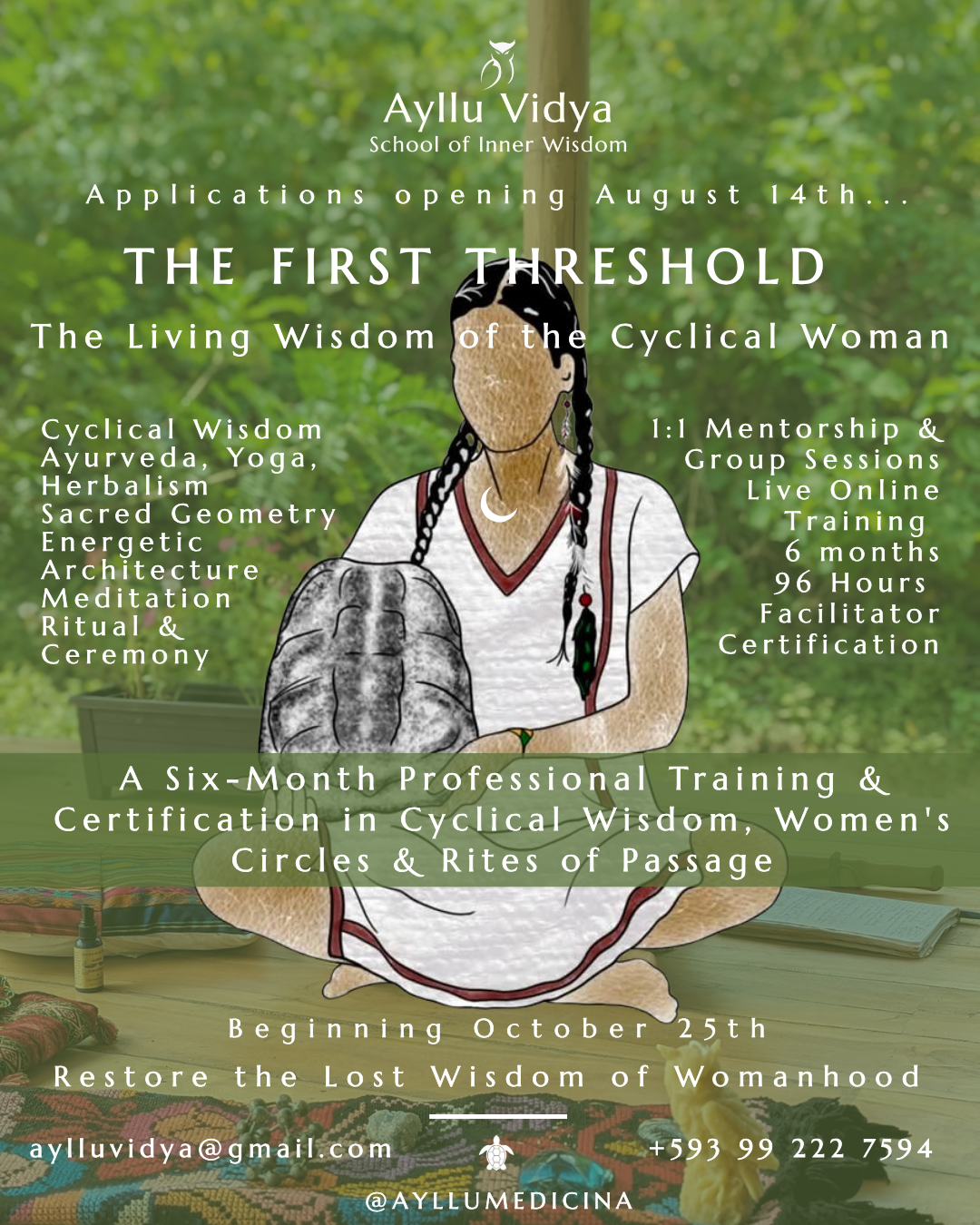
Our first professional training, The First Threshold: The Living Wisdom of the Cyclical Woman, grows from this philosophy. Over six months, women will explore cyclical wisdom, women’s circles, ritual, and foundational rites of passage while developing the knowledge and skills to bring this work into their own communities.
Education and community can prepare us for a profession and help us develop practical skills. It can also teach us how to move through life: how to recognize the thresholds we are crossing, draw on the wisdom of those who have gone before us, and accompany others through their own transitions.
At a time when so much of life happens through screens, when connection can be constant yet still leave us feeling alone, these questions become increasingly important.
What if we were never supposed to grow alone?
What if becoming who we are was always meant to happen in relationship, through the stories we inherit, the people who guide us, the communities that witness our becoming, and the rituals that help us recognize when one chapter of life is giving way to another?
This is why rites of passage still matter. They remind us that transformation is not something we simply move through. It is something we can mark, witness, share, and honour together.
This is the kind of education we believe is worth remembering. Ayllu Vidya is an invitation to learn differently: through experience, relationship, reflection, and community.
To remember that wisdom is not only something we acquire. It is something we embody, share, and carry forward. Registration for The First Threshold is now open, learn more here or contact us if you have any questions.

0 Comments