
What happens after a plant medicine ceremony ends? After the visions, insights, emotional releases, or moments of connection, the question is: how do we carry those experiences into our everyday lives? How do we integrate plant medicines, what we’ve seen, felt, and remembered in a way that creates lasting transformation?
Plant medicine can open a doorway into deeper awareness, bringing unconscious patterns, emotions, imbalances, and truths to the surface. But the ceremony itself is only the beginning. Without grounding, reflection, and supportive daily practices, these experiences can fade or become difficult to fully embody.
This is why, at Ayllu Medicina, we share various tools and practices for integration, including the ancient healing system of Ayurveda. This month, we spoke to our yoga instructor and Ayurvedic practitioner, Vanessa Lavigne, to learn more about Ayurveda. Read on to learn more about how Ayurveda and plant medicine are connected, and how they can balance you physically, mentally, and emotionally.
What Is Ayurveda?
Ayurveda is a holistic system of medicine, which has been practiced in India for thousands of years, with the Sanskrit name translating to ‘the wisdom (or science) of life’.
Ayurveda believes that what is in the cosmos is also within us, with each individual having a unique formation of the five elements: Ether, Air, Fire, Water, and Earth. These elements combine into three doshas:
- Vata (air + ether)
- Pitta (fire + water)
- Kapha (earth + water)
Ayurveda views each person as having an inherent constitution (prakruti), an elemental blueprint established at conception and relatively constant throughout life. Daily nourishment, environment, emotional experiences, and our relationships with others can disturb or support this balance, giving rise to changing states of imbalance (vikriti), which Ayurvedic practice aims to restore.
So Ayurveda does not just focus on treating symptoms or viewing health as the absence of illness. It focuses on health as a state of balance between the body, mind, spirit, environment, and nervous system, aiming to find the true balance and identify the imbalances of each individual. It aims to help people understand their unique nature and find balance once more, bringing more harmony and soul into the individual’s experience through various practices.
Ayurveda & Plant Medicine: What’s the Connection?
The connection between Ayurveda and plant medicine is rooted in a shared understanding that human beings are inseparable from nature, and that true balance depends on how we live in relationship with it.
Both approaches work with the intelligence of plants, but in slightly different ways. Ayurveda uses herbs, diet, and lifestyle to restore balance based on an individual’s constitution (prakruti) and current state of imbalance (vikriti).
Plant medicine traditions often use specific plants to open perception, release emotional patterns, and bring unconscious material into awareness, along with many other healing purposes. The medicine of plants can help harmonize the body, without people necessarily having a clear explanation as to how or why something occurred. Ayurveda can also work beyond the intellect, addressing the mind, body, and soul levels.
Another key connection is individuality. In both systems, the same plant or experience can affect each person differently depending on their body, mind, emotional state, and environment. Drinking Ayahuasca or sitting in a San Pedro ceremony is different every time, because people are different each time they meet with the plant medicines. Ayurveda also addresses this changing state of balance and interplay of the elements in each individual.
Both Ayurveda and plant medicine also view the synergy with plants. They do not view plants as substances, but intelligent bridges for the mind, body, and consciousness.
Another connection between Ayurveda and plant medicine is integration. Plant medicine can create expanded awareness or emotional release, while Ayurveda offers the daily framework to stabilize and embody those experiences through food, digestion (agni), nervous system regulation (vata balance), breathwork, and daily rhythm. This is why our June retreat is focusing on Ayurveda practices that participants can continue when they return home.
The Physical Body: Returning to Balance
Ayurveda understands that every individual carries a unique combination of the five elements: Ether, Air, Fire, Water, and Earth. These elemental qualities form our constitution, or doshic blueprint, influencing everything from digestion and energy levels to emotional tendencies and thought patterns.
There is no single path to healing because no two people are the same. After all, what nourishes one person may create an imbalance in another. Ayurveda recognizes that health is deeply individual, shaped not only by our constitution, but by climate, seasons, trauma, lifestyle, relationships, and even the stage of life we are moving through.
The natural world around us is constantly shifting, and we are continuously responding to those changes. Temperature, environment, stress, food combinations, sleep cycles, and, for women, our hormonal cycles, all influence our internal balance.
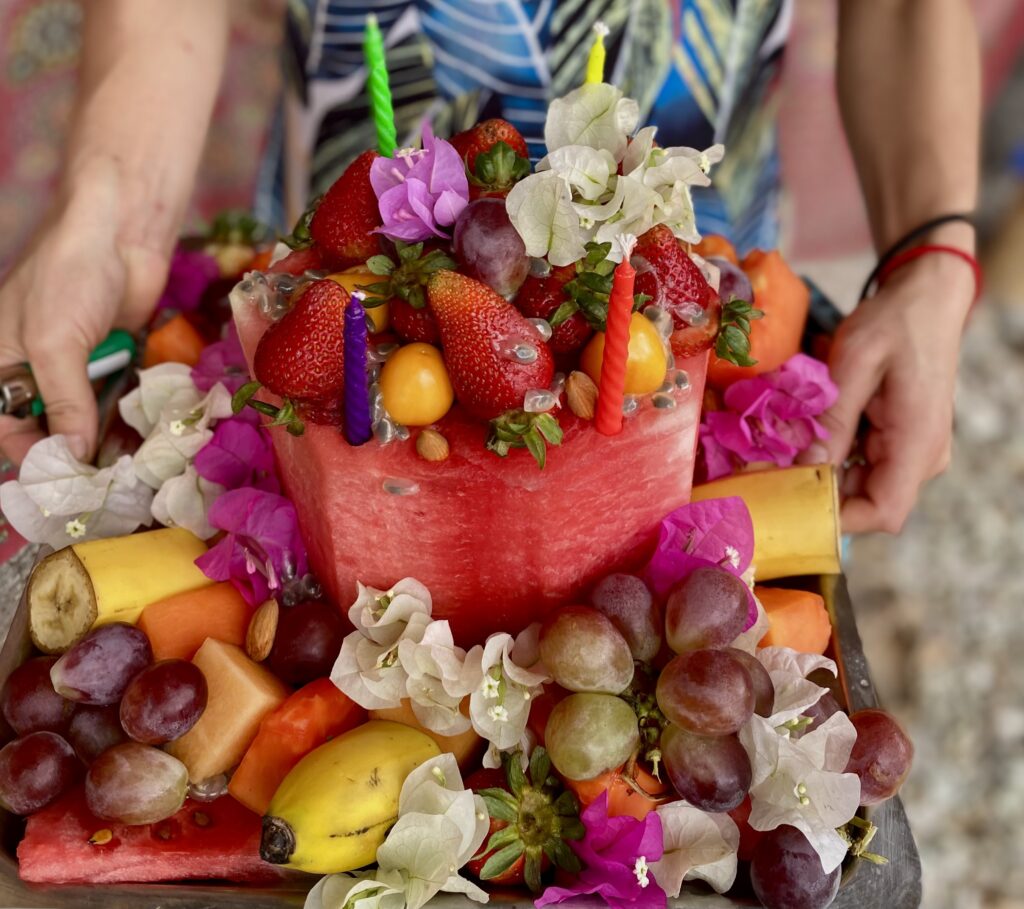
Ayurveda pays close attention to these relationships. It teaches that the body is always communicating with us, and that symptoms are often messages rather than problems to suppress. Physically, Ayurveda addresses things such as the diet of each individual, food combinations, and eating timings. It is one of the few systems that recognizes we are what we eat, not only based on combinations but also timings, along with giving space to women’s cycles and how this can impact food choices and practices throughout each month.
Ceremony & Diet
Plant medicine can help reveal these imbalances quickly and powerfully. Sometimes what arises in ceremony goes beyond the understanding of the intellect. Emotions surface, physical sensations can intensify, and sometimes old memories can emerge. The body begins releasing what has been held for years.
A plant medicine ceremony brings awareness to these releases, and then Ayurveda can help the body integrate the realizations physically, through nourishment, regulation, and movement. Similarly, the plant medicine dietas begins a cleansing and rebalancing before the plant medicine retreat. In Ayurveda, herbs are chosen for their qualities, such as heating or cooling, grounding or stimulating, clarifying or calming, based on how they restore balance within an individual’s constitution.
The Mental & Emotional Body
Ayurveda recognizes that emotional health and physical health cannot be separated. Long before we consciously remember experiences, the nervous system is already absorbing information from the world around us. Even during gestation, the emotional state of the mother, stress levels, nourishment, and environment are understood to influence the development of the child.
From an Ayurvedic perspective, unprocessed emotional experiences are not simply forgotten; instead, they can become stored in the body as subtle imbalances over time. When emotions are not fully expressed or worked through, they may accumulate in the nervous system for years, eventually manifesting as physical or emotional issues such as anxiety, fatigue, or tension.
In this way, what we cannot move through emotionally can shape patterns of stress, reaction, and perception in the body. This is why daily practices and purification rituals are considered important for regularly clearing and decluttering the system.
In this way, the question becomes: what are we still carrying that the body has not been able to move through?
It is also why emotional release can become such a powerful part of plant medicine ceremonies. What surfaces during these experiences is not random; it is often the body finally finding the safety and openness to release what has been held beneath the surface. Ayurveda also offers practices that support this emotional integration gently and consistently. These practices include:
- Pranayama (breathwork)
- Meditation
- Mantra
- Sound therapy
- Color therapy
- Yoga
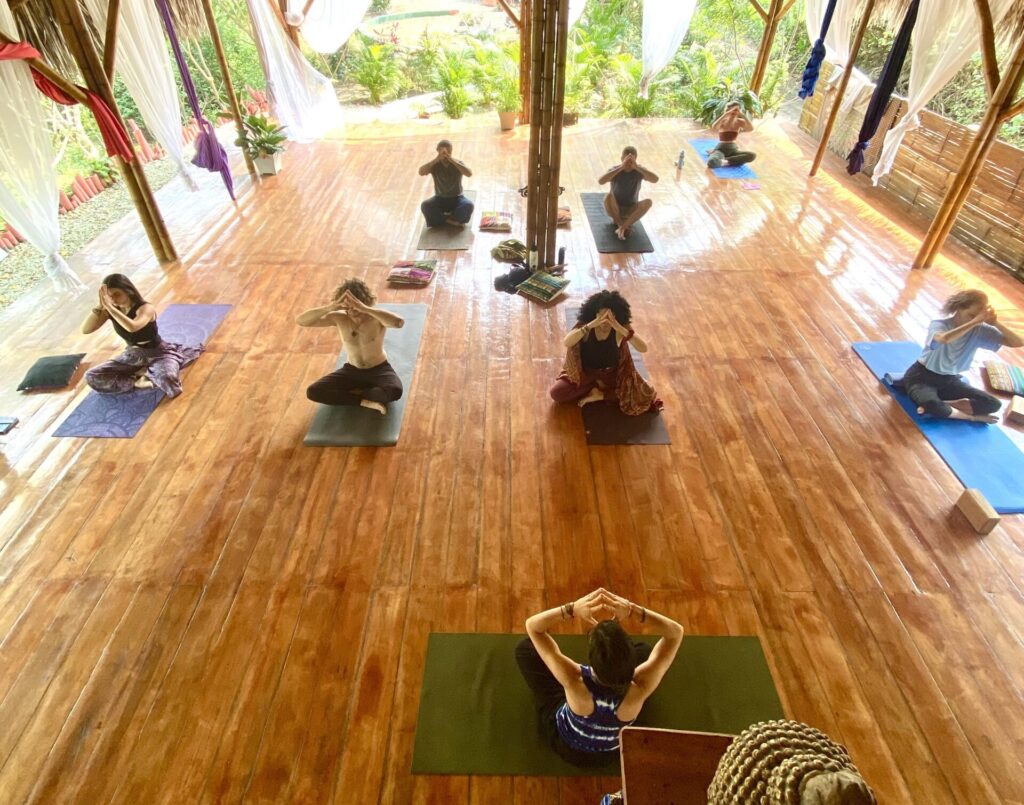
All of these are considered tools for balancing the mind and regulating the nervous system. Breath, in particular, becomes a meeting place between the physical and spiritual body. Breath is not only a way to shift physiology, but also consciousness. Often, plant medicine ceremonies, meditation, and other practices such as Ayurveda can begin to bring light to these spaces.
During Ayllu Medicina retreats we share daily yoga classes with breathwork and meditation, along with sound therapy to help restore and reset.
Udana Vayu and Singing: A Connection
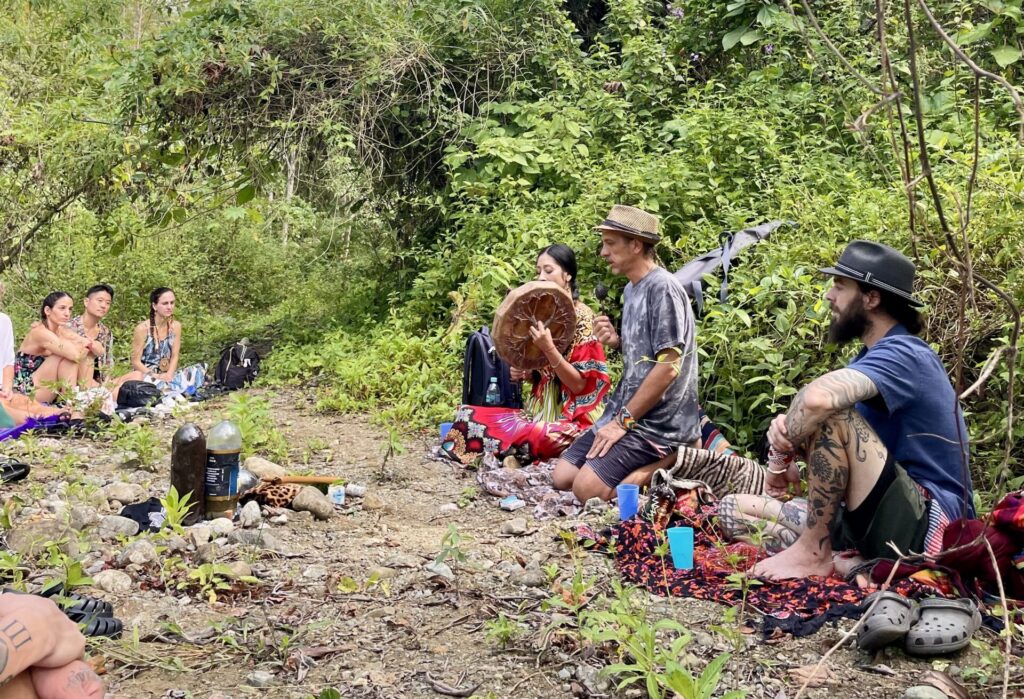
In yogic philosophy, the flow of prana is understood through different energetic movements, or vayus. One of these, Udana Vayu, governs expression, speech, and the upward movement of consciousness. It is associated with the throat and higher awareness. Practices such as chanting, singing, prayer, and intentional sound help activate this channel, supporting not only emotional release, but also clarity, expression, and reconnection to a deeper sense of awareness.
This connects to plant medicine ceremonies: sound, silence, breath, and prayer are such essential elements. They help regulate the nervous system while also opening subtle pathways of perception. This is why at Ayllu Medicina retreats, we also share music and song circles, so people can connect with their own voices.
Within this context, plant medicine can be seen as an accelerant, something that brings what is held within the system into direct awareness. However, plant medicine alone is not the full process. The environment, intention, emotional safety, nervous system state, and capacity for presence all shape the experience. (link ayllu)
Ceremony can therefore act as a reset point, being a space where the usual patterns of the mind soften, and we are given the opportunity to reconnect with ourselves beneath conditioning, emotion, and mental clutter. The depth of what is received in those moments is then carried forward through integration, where Ayurveda offers some grounding practices to embody what has been revealed.

The Soul Body: Remembering Our True Nature
Beyond the physical body and emotional mind lies another dimension of healing: the remembrance of who we truly are. Many spiritual traditions teach that suffering arises when we become disconnected from our true inner essence, when we identify only with the mind, the body, or our external circumstances. Plant medicine ceremonies can create moments where that separation dissolves and the remembrance of the connection to the whole returns.
Ayurveda focuses on putting more soul (or awareness) into the body through intention, awareness, and mindfulness. Plant medicine can also reveal moments where we remember our connection to nature, to spirit, to our ancestors, to each other, and to something greater than ourselves.
These experiences often go beyond language or intellectual understanding. They are felt directly through the heart. Ayurveda and yoga both teach that the body is not an obstacle to spiritual growth, but a vessel through which consciousness can awaken more fully.
At Ayllu Medicina, we see ceremony not as an escape from life, but as a way to become more present within it. The goal is not to chase extraordinary experiences, but to bring awareness into ordinary moments, including how we eat, breathe, move, speak, rest, and care for ourselves each day.
The real integration happens after the ceremony ends. Through consistent practices, intentional living, and self-awareness, finding alignment slowly becomes less about seeking something outside of ourselves and more about remembering the balance that has always existed within.
As the nervous system becomes more regulated and the body more balanced, we become more capable of sitting with ourselves in stillness. Then meditation deepens, awareness expands, and intuition becomes clearer. Healing then becomes more than simply removing pain. It becomes a process of alignment with purpose, truth, and that deeper intelligence already living within us. .
Ayurvedic Practices
One of the most important aspects of healing is regulating the nervous system. When we are constantly overstimulated, anxious, disconnected, or exhausted, it becomes difficult to access clarity, intuition, or deeper states of awareness.
Ayurveda offers grounding practices that help bring the body back into balance. Some Ayurvedic practices include Shirodhara, which is a warm oil or hebal liquid being poured onto the third eye area to reduce excess ‘Vata’ and calm the nervous system, bringing altered states of awareness. Another of these practices is Abhyanga, warm oil self-massage. Traditionally done with sesame oil for grounding or coconut oil for cooling, Abhyanga helps nourish the tissues, calm the nervous system, lubricate the muscles and joints, and support the body’s natural healing processes.
In yoga therapy, we often see how imbalance develops through compensation patterns within the body. One side becomes constricted while another overextends to compensate. Pain is not always caused by weakness or tightness alone, but by instability and disconnection. Healing is not always about pushing deeper into flexibility. Sometimes it is about creating stability, awareness, and support.
Through mindful movement, strengthening, breath, posture, and therapeutic practices, the body gradually relearns harmony. At our retreats, we have daily yoga classes and, in June, we will be sharing more about Ayurvedic practices.

The Ceremony Continues: Ayurveda, Yoga, & Plant Medicine
Plant medicine can reveal hidden truths and reconnect us to the sacredness of life. In this opening, something essential is remembered, but what follows is just as important: how we live with what has been revealed.
This is where Ayurveda can become a guide for integration and everyday life. It offers practical ways to embody insight through daily rhythm, through food, breath, movement, rest, ritual, and self-awareness. In this way, what is experienced in the plant medicine ceremony is not left as a memory but gradually woven into the body, the nervous system, and everyday life.
Through this ongoing relationship with ourselves, the body, mind, and spirit begin to come back into harmony, not through force or effort, but through consistency, presence, and care. Integration is the path; once the ceremony opens the door. And at Ayllu Medicina, we share practices to help guide you, so we can remain in our heart space, in balance, once the ceremony of life begins.
If this resonates with you, we invite you to join us for our June Fire of the Heart Retreat, where we will explore this connection more deeply through plant medicine ceremonies, yoga, heart technology meditations, and Ayurveda workshops. Together, we will work with tools that support both expansion and integration, learning how to return to balance not only in moments of insight, but in the way we live each day.
Contact us to learn more!


0 Comments